Showing posts with label bread. Show all posts

Monday, March 28, 2011

Whole Wheat Sandwich Bread

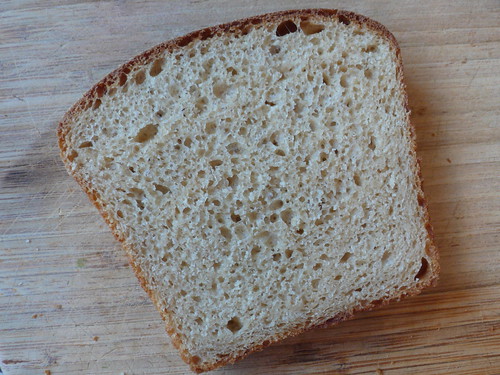
Cooks Illustrated Magazine recently published a recipe for Whole Wheat Sandwich Bread, and I've made it a few times now.  It is complex and nuanced, wheaty, slightly sweet, and very wholesome -- in a good way.  There are lots of steps, but it's totally worth the payoff.

As I often do with recipes, I have made a few tweaks and changes here and there to streamline the process and tailor the flavor to my family's tastes.  I've included step-by-step photos so that this should be doable, even if you've never made bread before.


Note that, while this bread comes together pretty easily, there are two stages and three rises, so be sure to plan accordingly.  The Soaker and the sourdough starter (the Biga) must be started either the night before, or early in the morning of the day you intend to bake this.  Also, this bread requires either a KitchenAid/stand mixer with a dough hook, or strong arms and a sturdy spoon to mix the dough (although I've never tried it without my trusty KitchenAid).


Whole Wheat Sandwich Bread
Adapted from Cook's Illustrated Magazine
Yield 2 loaves

Biga
2 cups (11 ounces) bread flour
1 cup (8 ounces) warm water (100-110 degrees)
1/2 tsp instant or rapid-rise yeast

Soaker
3 cups (1 lb, 2.2 ounces) whole-wheat flour (use King Arthur White Whole Wheat if possible for a milder "wheat" flavor)
2 cups (16 ounces ) whole milk

Dough
3 tsps. table salt
2 scant tablespoons yeast
1/4 cup honey
1/2 cup unsalted butter,  very soft (room temperature/melted)
1/2 cup bread flour

The day before (or early in the morning):
Combine the ingredients in the biga/sourdough starter and mix until no dry spots remain and it forms a rough dough.
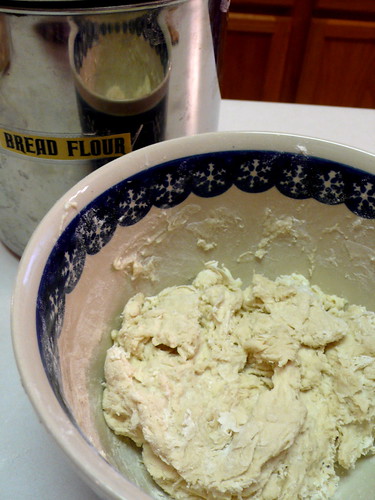


Combine ingredients for the soaker and stir until it becomes a thick dough/paste.
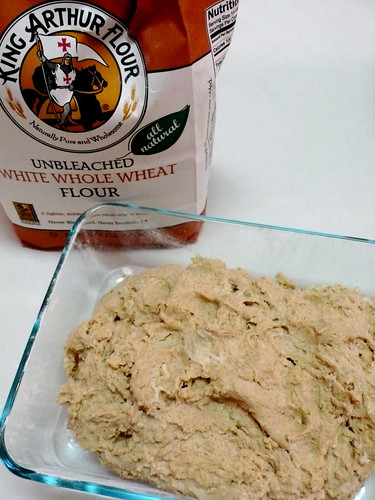
 

(The bag in the background is what "white whole wheat" looks like.  It's not a white flour blend -- it's simply a white colored wheat berry that makes a lighter looking and milder tasting whole wheat flour.)

Cover the biga and soaker (I use a plate on top of each bowl).  Place biga on the counter, and the soaker in the refrigerator for 8-24 hours.

When you are ready to put the dough together, gather your other ingredients, as well as the biga and soaker.  Your soaker will have a slightly sour/sulpher smell to it, but don't worry, it's going to taste wonderful once it's all baked.  The biga should have gone all bubbly like this:
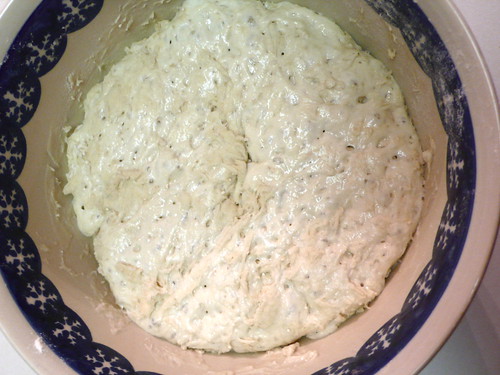


Scrape the biga into a mixing bowl.  Break the soaker into smallish pieces and put into the mixing bowl on top of the biga (this helps it mix together much more easily).
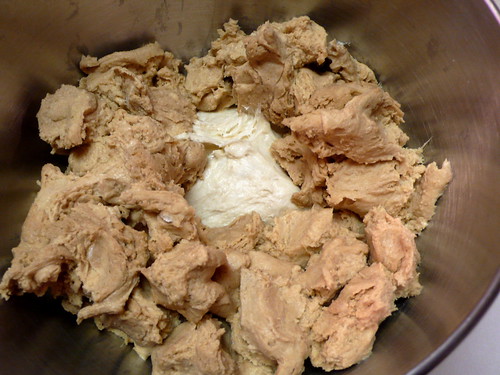


Add the salt, yeast, butter and honey, and, using a stand mixer fitted with a dough hook (or a sturdy spoon), beat the dough on low until it all comes together (about 5 minutes) into a cohesive, sticky mass.  Add the 1/2 cup of bread flour, and mix on low for another 5 minutes until the dough pulls away from the sides of the bowl and forms an elastic ball around the hook.
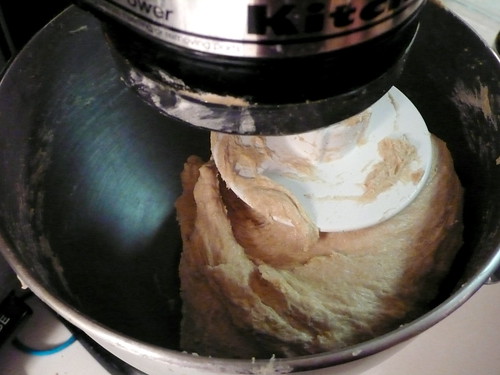


(Yes, my mixer is covered in flour.  And no, I did not bother to wipe it down.)


NOTE: if you only want to bake one loaf now and save the other half for later, now is the time to divide it.  Cut the dough in half, freeze half of it in a plastic bag, and proceed as follows.

Take the dough out of the bowl to oil it (the bowl).  Form dough into a ball by pulling with your fingertips from the bottom of the mass up to the top, like you're stretching a skin over it.  Once it is gathered into a ball, place dough back into the oiled bowl.
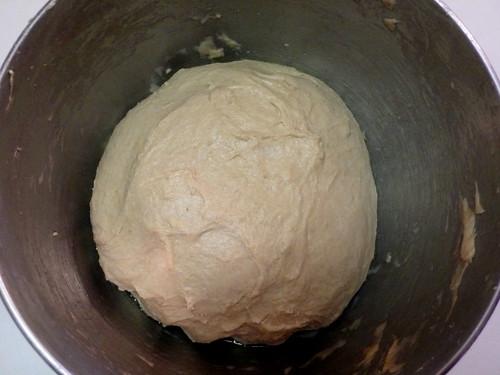


Cover and let it sit in a warm-ish, draft-free area, until it has doubled in size (sometimes 45 minutes, sometimes 2-1/2 hours.)  If your dough won't rise, set your oven to the lowest temperature.  Once it has heated up, turn it off, turn your oven light on, and put a pan of steaming water in the bottom.  Place your dough bowl (covered) on a rack, and let it rise.  (My kitchen was ice-cold this morning, so I had to utilize this little trick.)
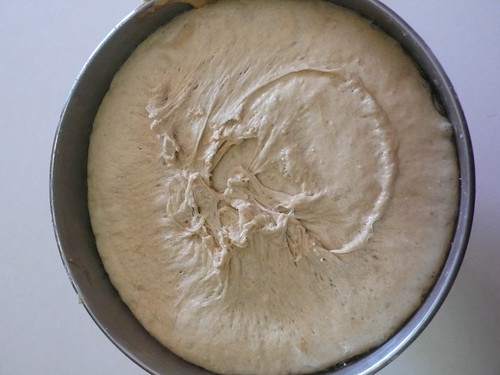
 

(This was covered with a plate to rise, and the dough rose up to the bottom of the plate, so it bears the marks.)

Once the dough has doubled, use your fingers to fold it like this:
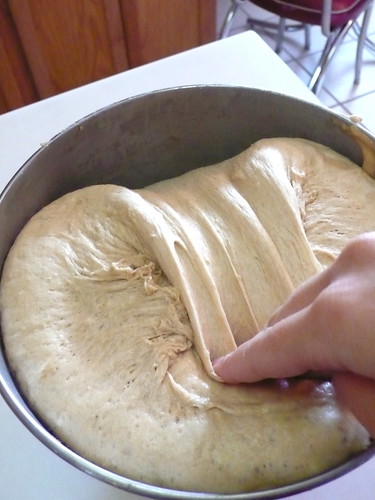


Turn the bowl 45 degrees and repeat.
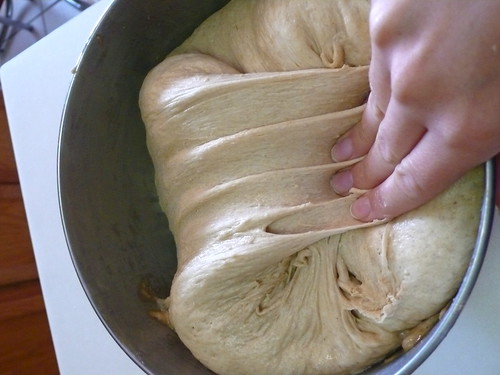


Keep turning the bowl and folding to make a total of 8 folds.  Re-cover the bowl, and set aside to rise again (approx. 45 minutes, or until doubled.)

Butter two bread pans.

Tip dough out onto a floured counter and cut in half.  Roll one half tightly into a cylinder, tucking the ends under, and place in a buttered bread pan.  The dough will be a bit unweildy, but don't worry -- just do your best.  Repeat with the remaining half.  Preheat your oven to 375 degrees.

Allow bread to rise, uncovered, for 30 minutes, until it has risen approx. 1 inch above the bread pan.  It should look like this:
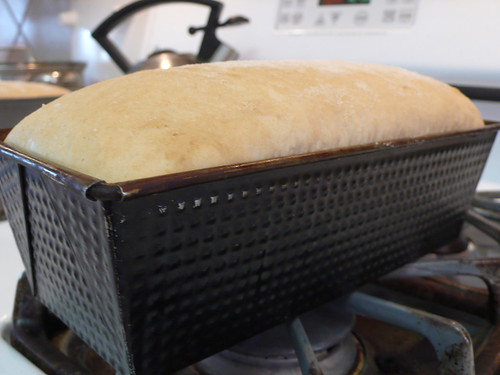


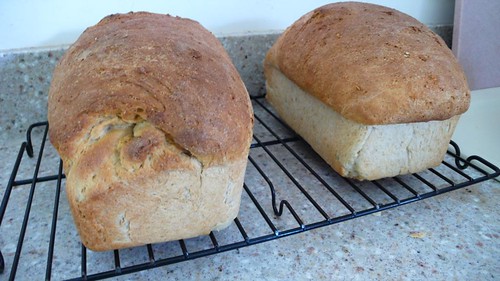
Bake for 35 minutes, or until an instant-read thermometer inserted in the center of the loaf registers at 210 degrees.  Immediately tip bread out onto a cooling rack (if bread won't come out easily, let it sit and steam inside pan for about 10 minutes, then try again -- it should come right out.)

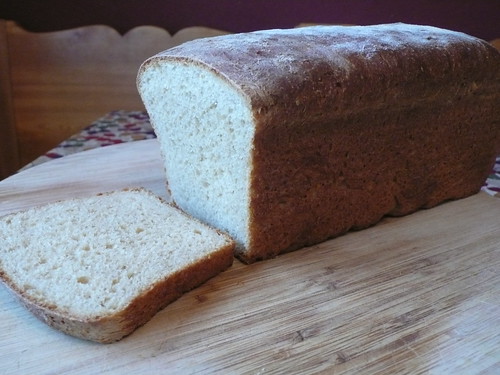
Enjoy!
 

Thursday, October 30, 2008

Honey Whole Wheat Bread

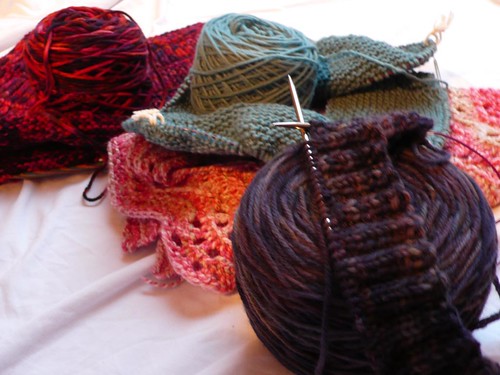
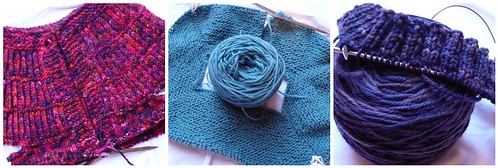
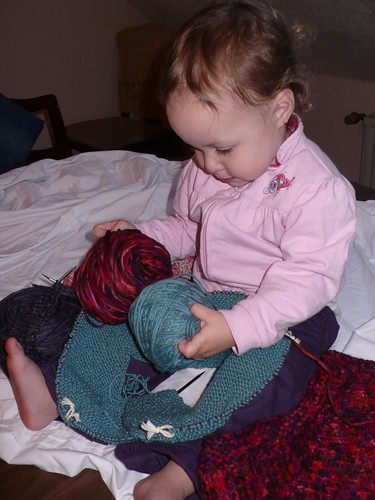
The nesting urge has taken over, and the funny thing about it is that it's entirely unpredictable. With each child there's been a different flavor to the madness, and this time, it's sweaters for myself. I'm entirely certain that the world could cave in if I don't complete as many sweaters as possible before the new person makes The Appearance, and there's no fighting it.


Yes, you'll notice a finished Liesl there under it all, but the official FO pic will have to wait until I can take a decent picture of it on me. Basically, during any moment I have to myself, I feel compelled to knit, not style a shot, so that's the story.


I haven't shared a recipe in a while, and since the Knitting Cook site is now officially down (oh yeah, I'm pretty sure that I forgot to mention that I just can't podcast anymore, so.... sorry 'bout that.), I decided to post my Honey Whole Wheat Bread here. Also, I made a tiny change in the flour balance, which I like even better, so here is the updated version.


Presenting: the recipe for the Honey Whole Wheat bread that I make several times a week. It's great plain fresh out of the oven, in a savory sandwich, as toast with butter, french toast, or whatever else you want to do with it. The bread is flavorful with honey and butter, but not so overtly that you can't use it in a good, hearty, BLT.

This is my version of my mom's original recipe. I am completely happy with this recipe, but feel free to vary it according to your own taste, adjusting the balance of whole wheat to white flour, etc.


Note: These directions assume that you are making this recipe by hand. If, instead, you are using a substantial stand mixer (like a Kitchen Aid) or a bread machine, add the liquid first, then the dry, and break the egg on top of it all. If you're using the bread machine, you will want to add both cups of whole wheat flour right away -- just check on it after it's been kneading for a little while to see if it needs more flour or a few more tablespoons of water.


Combine in large bowl:
1 cup whole wheat flour (you will need one more cup after liquid ingredients have been added)
1-1/2 cups white bread flour (very important that it's bread flour and not all purpose)
1/3 cup rolled oats (I use Old Fashioned Rolled Oats)
1 tsp salt
1 scant Tablespoon yeast
1 heaping Tablespoon Vital Wheat Gluten

Melt:
1/4 cup (1/2 stick) butter

Add:
1/4 cup honey
1 cup water

Warm in microwave or stovetop to 110-120 degrees (it's almost too hot for my finger to stay in it for more than 2 or 3 seconds when it's this temp.)

Time and clean-up saving tip: melt the butter in a 2-cup glass measuring cup, add honey until it reaches the 1/2 cup mark, then add water to the 1-1/2 cup mark. Put all in microwave together -- in mine it takes 50 seconds to get to the right tempurature, and in my parent's microwave it takes just over a minute.


Add wet ingredients to dry, along with:
1 egg

Stir with wooden spoon until combined.

Add:
1 cup whole wheat flour

Tip out onto lightly floured surface, and knead for 5-8 minutes to build up gluten in flour, adding more flour as needed to keep it from sticking. Knead until smooth and elastic. (There are videos on YouTube that show you how to properly knead bread if you've never done it.)

Grease bowl and place ball of dough inside (I spray PAM on the the inside of the bowl, put the dough in, then spray the top of the dough to keep it from sticking). Put a piece of waxed paper over the bowl, then a kitchen towel to insulate.

Allow dough to rise until doubled (this may take anywhere from 1 to 2 hours depending on your house, your yeast, the weather outside, and many other factors I have yet to determine). You will know that it's ready when it looks like twice the original amount, and when you stick your fingers in the top about two inches down, the indentation stays and doesn't spring straight back up.

If you are having extra trouble getting your dough to rise, or are in a rush, turn on your oven to the very lowest setting. Place some boiling water in an oven proof bowl or pan in the bottom of the oven, and put your bowl of dough on one of the oven racks. Turn off oven when it gets fairly warm, and your dough should rise nicely. (Thanks to MA for that great tip!)

Pull dough out of bowl, and roll up into loaf shape, pulling a "skin" of dough around the whole thing to smooth it over. Place in greased loaf pan. Cover once again with waxed paper and kitchen towel, and leave to rise until doubled (this, once again, will vary in time, but expect at least an hour unless you have an especially "yeasty" house.)

Once the loaf is risen to your liking, put into a cold oven, and turn the heat on to 350 (you could pre-heat the oven, but putting it in cold gives it the extra punch to rise just a bit more). Bake until suitably golden on top -- in my oven this takes 35, and at my parent's house this took just under 30 minutes. An instant-read thermometer stuck into the loaf will read 200 when the bread is completely baked through.
Note: if you badly jar the loaf when putting it into the oven, it could deflate. If this happens, you will need to re-form the loaf and let it rise again in a re-greased pan.

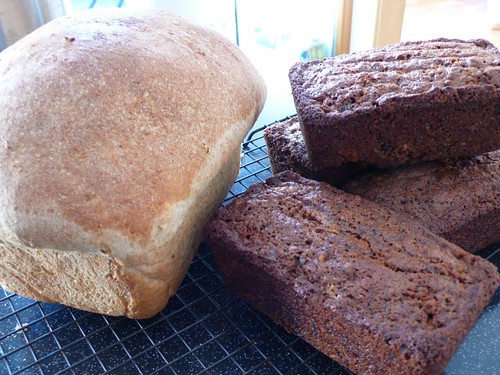
Turn out immediately on to a cooling rack. This bread slices best when it's completely cooled, but seriously. Who wants to wait?

(Pictured here with mini-loaves of date-nut bread)

OK kids, I've got to get back to my knitting. I am helpless to resist.
Blogged with the Flock Browser

Friday, September 26, 2008

To compare: Lendrum vs. Fricke

This morning started out with bread in the oven:

Honey Whole Wheat and mini-loaves of Date-Nut bread

We opened the boxes containing our official homeschooling curriculum,

and completed a successful day of learning.

I've also got most of the laundry washed and hanging out to dry, so I feel pretty accomplished for 3:30 in the afternoon! (As our washer is tiny and takes 2 hours per load, and dryer doesn't dry, laundry is a full-day affair here what with all of the hanging out and running up and down stairs that needs to happen.)

Currently on the needles for playground knitting and movie watching:

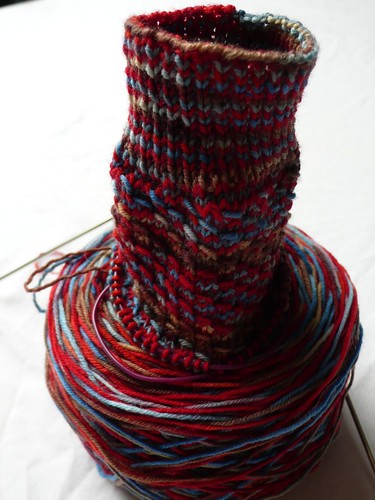
Show-Off Stranded Socks by Anne Campbell (PDF and Ravelry links), knit Magic-loop on KnitPicks classics (2.5mm, 32" cables) in Spunky Eclectic "Time Of The Month" colorway (rage, chocolate and tears).

Currently on the wheel:

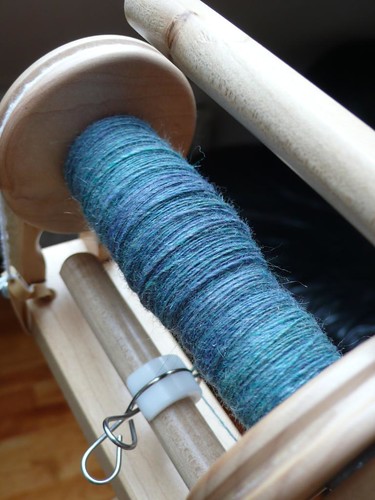
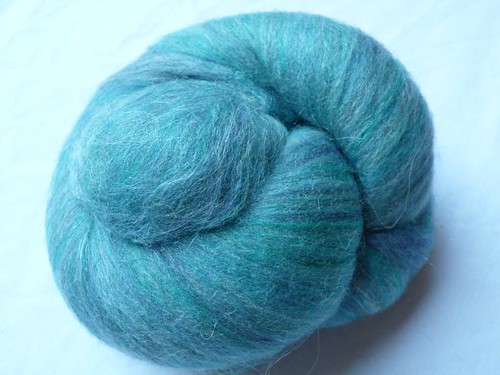
Fine "Bluegrass" singles for a laceweight 2-ply

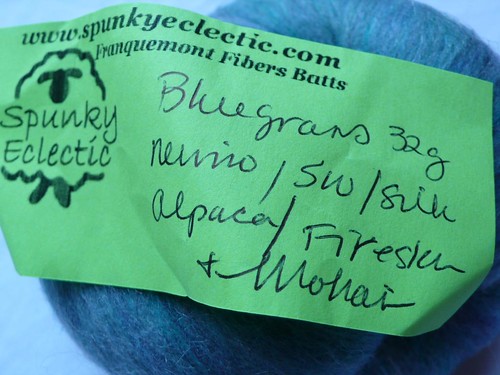
I'm working from this fantastic 1oz Franquemont Fibers batt I purchased from Spunky Eclectic sometime over the summer:


I'm interested to see how many yards I can get out of just the one batt.

It's got to be the most enjoyable spinning experience I've ever had, truly. If you're a spinner and you've never tried one of Abby's batts, you must.


Her fibers are blended with a purpose (she says that the superwash wool in this blend create a slightly tougher yarn while allowing for the luxury spinning experience, and the pure merino is kind of like the "glue" to hold it all together -- this lady knows what she's talking about here.)

I'm greatly enjoying spinning on my Lendrum again, which I had missed so much over the summer. Speaking of wheels, a belated update on the Fricke back in NY -- thanks to Amy's suggestion (whom I had bought the wheel from), I took the treadle off the wheel, the wheel off the frame, switched the two identical looking screws, and it now works perfectly!

Having gone from one wheel to the next so recently, I can tell you by comparison that the Fricke has an easier treadling action, larger orifice, bigger bobbins, more ratios on the one maiden head; the Lendrum has more solid wood, an overall slightly sturdier feel, a more direct orifice, more options for upgrading (with the jumbo plying head, quill head, and very-fast-flyer). Very flexible wheels both, it is hard to choose just one. I say go with your budget, you really can't go wrong with either. No matter what though, there will always be a special place in my heart for my lovely Lendrum. It's good to be together again.
Blogged with the Flock Browser

LinkWithin

Related Posts Plugin for WordPress, Blogger...